


How to Choose Your Tuning Fork
Tuning forks can look deceptively simple—two tines, a handle, and a clear ringing tone. Yet once you step into the world of Hz values, weighted versus unweighted designs, harmonics, binaurals, chakras, and brainwave states, it can feel like you’ve entered an entirely new language.
This guide is here to slow everything down.
Our intention is not to overwhelm you with theory, but to help you understand how tuning forks are used in real practice, what types of forks tend to support different intentions, and how to choose tools that will genuinely serve your work—whether that’s personal meditation, self-care, therapeutic practice, or deeper consciousness exploration.
All Sunreed™ tuning forks are made in the USA from high-grade aluminum alloy selected for long-term durability and integrity of tone. We guarantee pitch accuracy within ±0.25% (0.0025). With every tuning fork purchase, we also include a free educational download with practical recommendations for therapeutic use.
You’re welcome to read this guide straight through, or return to sections as you listen to sound files and feel into what truly calls to you.
1. Where to Begin With Tuning Forks
If you’re just starting out, you don’t need a large collection. What you need is a clear, usable beginning—something you can work with immediately and grow alongside.
For most people, the simplest and most effective foundation is a two-fork harmonic set, especially in weighted forks. Two forks tuned in a pleasing musical relationship can be used in multiple ways:
- near the ears for focused listening
- on the body to transmit vibration into tissue
- together, allowing the harmony to be felt through the whole system
Harmonics are one of the most accessible ways of working with sound. They naturally invite slower breathing, release of tension, and a gentle uplift in mood and awareness.
If you’d like a slightly deeper starting point, the Sunreed Starter Set expands this foundation. It includes a harmonic C and G pair tuned to 432 Hz for relaxation, alignment, and bodywork, along with an additional fork designed to pair with the G to create a Theta binaural. Theta brainwave ranges are commonly associated with deep sleep and deep meditation, and many people find Theta stimulation supports quieting the mind and releasing habitual thought loops.
2. Weighted vs. Unweighted Tuning Forks
Every tuning fork has a handle and two tines. The key design difference you’ll encounter is whether the fork is weighted or unweighted.
Weighted tuning forks have small weights attached to the ends of the tines. These weights increase how strongly vibration travels down the handle and into the body. This makes weighted forks especially effective for:
- direct body application
- areas of chronic tightness or discomfort
- chakra and acupuncture-point work
Weighted forks can certainly be heard, but their primary effect is felt. They tend to be most audible when placed on the body or brought close to the ears.
Unweighted tuning forks do not have weights on the tines. They transmit less vibration into tissue, but their sound carries more clearly through the air. They often produce both a clear fundamental tone and a higher overtone, making them well suited for:
- listening-based practices
- scanning the body
- subtle biofield or “feathering” work
Many practitioners eventually use both types—weighted forks for deeper tissue and energetic work, and unweighted forks for listening, atmosphere, and subtle field applications.
Both types are activated the same way: hold the fork by the handle so the tines move freely, strike it gently and deliberately, and use the brief sustain window intentionally.

3. Clearing and Aligning: Two Complementary Practices
In many holistic and wisdom traditions, healing unfolds through two complementary movements.
The first is clearing—releasing what is non-beneficial, painful, or stuck.
The second is aligning—remembering and embodying what is already whole, coherent, and true.
Clearing alone is rarely the full story of healing. If we only focus on removing what is “wrong,” we may forget to cultivate and stabilize what is wise, compassionate, and inherently present.
Tuning forks can support both movements.
- Binaural tuning forks often support clearing. Strong binaural oscillations make it difficult for the mind to cling to habitual patterns, allowing thought loops to soften and awareness to open.
- Harmonic tuning forks often support aligning. Harmonious intervals naturally create coherence and “rightness,” supporting integration, relaxation, and embodiment.
Many practitioners find the most depth comes from working with both—clearing what no longer serves, while aligning with what is most essential.
4. What Hz Frequency Is “Best”?
“Hertz” (Hz) simply means cycles per second—it describes pitch. Higher Hz equals a higher tone; lower Hz equals a deeper tone.
Online, you’ll encounter strong claims about specific frequencies—432 Hz, 528 Hz, 111 Hz, 136.1 Hz, and many others. Some come from symbolic frameworks, some from musical or philosophical exploration, and some from emerging scientific inquiry. Many claims, however, are anecdotal rather than evidence-based.
A grounded way to approach frequency is experiential:
- Lower frequencies tend to move into the body more readily
- Midrange frequencies are often easier and more pleasant to listen to
Rather than searching for a “magic” frequency, we encourage you to focus on how you listen. Sound becomes most effective when paired with clear intention, steady attention, and understanding.
That said, precision does matter in certain cases. Binaural stimulation requires exact frequency differences, and harmonic relationships must be mathematically accurate. These are areas where thoughtfully designed sets truly matter.
5. Harmonic Tuning Fork Recommendations
Harmonics are the backbone of much modern sound work. They are based on simple mathematical ratios found throughout nature, and they tend to create a natural sense of balance and uplift.
The Body Tuners (C & G perfect fifth) are one of the most reliable starting places for harmonic work. The perfect fifth is deeply stabilizing and has been studied for its relationship to nervous-system relaxation and nitric oxide release, contributing to warmth and well-being.
Other harmonic options include:
- Ohm Octave Set – spacious, centering, and quietly profound
- 3rd-octave harmonic sets – offering thirds, fourths, fifths, and octaves that carry vibration into the body while remaining clear to the ear
- 111 Holy Harmonies – inspired by ancient sound chambers and sacred proportions, often used in ritual and feminine mysteries work
Listening is the best guide. Use headphones when possible and notice which intervals your body naturally settles into.
6. Binaural Tuning Fork Recommendations
Binaural stimulation arises when two tones are presented at slightly different frequencies. Rather than hearing two separate notes, the nervous system perceives a subtle pulsing or oscillation that reflects the difference between them. This effect occurs not in the sound itself, but in how the brain and nervous system respond to the relationship between the tones.
Through EEG research, several broad brainwave ranges have been identified—Delta, Theta, Alpha, Beta, and Gamma—each associated with different states of awareness and function. Binaural stimulation has been explored as a way to gently support these states, and remains an active area of scientific inquiry.
In practice, many people experience these ranges in the following ways:
- Delta supports deep rest and nervous system downshifting, often felt as grounding and restorative.
- Theta is associated with deep meditation, intuition, and reduced attachment to thought.
- Alpha reflects relaxed alertness and calm, centered presence.
- Beta relates to focus, engagement, and clear mental activity when used gently.
- Gamma is linked to heightened integration and clarity, and is being explored in research related to cognitive and neurological function.
Sunreed’s Gamma Wave sets are tuned with a precise 40 Hz difference to support Gamma-range effects, while our Brain Tuners offer Delta, Theta, Alpha, and Beta options for exploring different states. As with all sound work, the most meaningful results arise when binaural stimulation is paired with mindful attention, intention, and listening rather than expectation.
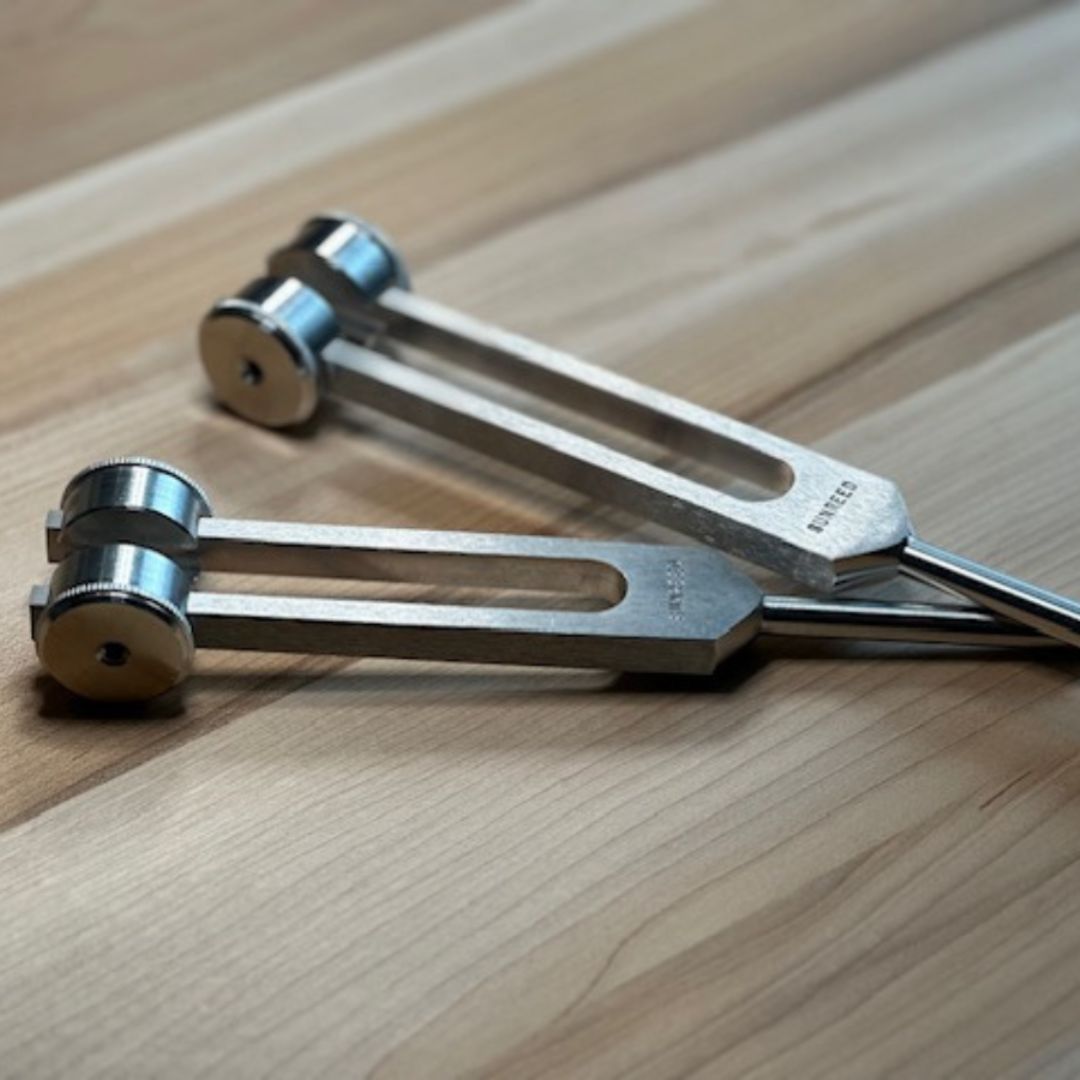
7. Sunreed’s Clear Path Tuning Fork Set
The Clear Path Set is a unique two-fork weighted pairing based on frequencies derived from biogeometry research into biological field coherence.
These forks are intended to be used together and support clearing non-beneficial energetic patterns from the biofield. Over the years, we’ve heard many meaningful stories from people working with this set.
They are not background instruments—they are tools of focused intention and direct application.
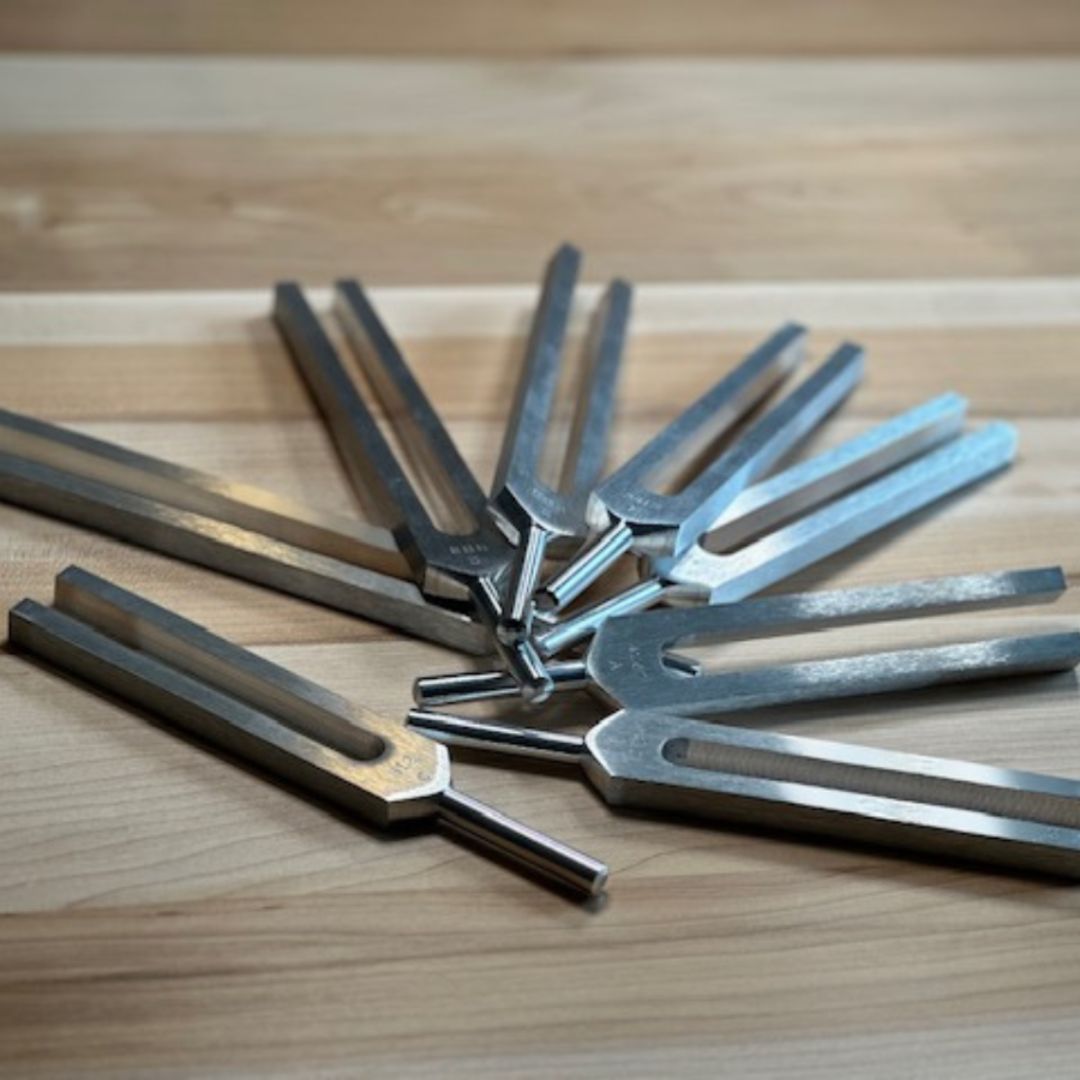
8. Sunreed’s 3rd-Octave 8-Fork Chakra & Harmonic Set
For those seeking a more complete toolkit, the 3rd-octave 8-fork weighted set offers a full octave designed for both chakra-based work and harmonic exploration.
Because these forks are weighted and sit in the third octave, they transmit vibration into the body clearly while still offering rich harmonic relationships within the set.
We encourage anyone working with chakras to study their deeper nature—not just note associations. Education brings clarity and power to the practice. Resources like Wheels of Life by Anodea Judith are excellent companions to this work.

9. Crystal Attenuators: Merging Sound, Light & Geometry
For practitioners using weighted forks on the body, Crystal Attenuators offer a meaningful enhancement.
Designed to fit over the foot of most tuning forks, they feature:
- a Flower of Life etching
- a permanently set gemstone
- increased surface area for vibration transfer
Sound, light, sacred geometry, and intention meet in one integrated tool. These attenuators were designed by Dorothy Stone and handcrafted in the USA by a master machinist aligned with consciousness-based work.
10. Science, Intention, and Responsible Use
Research into tuning forks continues to grow, including studies related to relaxation, mood, sleep, pain relief, and physiological responses. At the same time, we encourage discernment around claims that exceed current evidence.
Tuning forks are powerful complementary tools—especially when paired with mindfulness, therapeutic skill, and ethical practice. We do not make medical claims, and we encourage consultation with licensed professionals when appropriate.
From our perspective, instruments open the door—but awareness walks through it.
11. Made in the USA. Supported by Real Humans.
All Sunreed™ tuning forks are made in the USA and selected for integrity of tone, durability, and long-term reliability. If the options feel confusing, you don’t have to navigate them alone.
We answer the phone.
We take time.
We’re here to help you find tools that truly fit.
Let us support your tuning fork journey—one clear tone at a time.