


How To Choose A Quartz Crystal Singing Bowl
Buying a quartz crystal singing bowl can feel like stepping into a new language. Frosted, clear, empyrean, gemstone fusion, handle bowls, 432 Hz, 440 Hz, chakras, harmonics, binaurals—it’s a lot.
This guide is here to slow everything down.
Our intention is to walk beside you, not overwhelm you: to help you find a bowl or set that truly resonates with you, supports your practice, and makes sense both musically and energetically. Along the way, we’ll share what we’ve learned from decades of work in sound, healing, and consciousness.
Use this as something you can sit with, return to, and highlight as you explore.
1. When Looking for a New Singing Bowl, Begin With What You Actually Need
Before worrying about notes, tunings, and sets, it helps to ask a few simple questions:
- How do I imagine using this bowl?
For myself? With clients? In groups? In movement-based practices like yoga? - Do I need this bowl to travel?
Will it be mostly at home, or in and out of the car, studios, or offices? - Do I want one bowl that I can bond with deeply, or am I feeling called to a set?
There is no “best” bowl in an absolute sense. There is only what fits you—your body, your voice, your space, your work, and your intentions. This guide is meant to bring you closer to that fit.
2. The Main Types of Quartz Crystal Singing Bowls
Crystal bowls come in several main styles. Each has its own “personality,” strengths and ideal uses.

Frosted Bowls
Frosted bowls are the classic white crystal bowls that many people think of first. They are opaque, with a slightly rough outer surface. Because the walls are thick, they hold a great deal of vibration and are very sturdy. This makes them the loudest and most powerful of the crystal bowl family.
For beginners, they are usually the easiest to play. A frosted bowl starts to sing quickly and sustains a clear tone for a good length of time. You don’t have to fight with it to get sound; you can focus more on the meditation, group, or client in front of you.
Frosted bowls are often the most affordable option and are well-suited to sound baths, yoga classes, and any situation where you want the sound to clearly fill a room.

Empyrean Bowls
Empyrean bowls share many qualities with frosted bowls—they are white, thick, strong, and similarly powerful in volume. The key difference is the finish. Instead of a rough exterior, empyrean bowls are carefully hand-polished smooth.
This smoother surface gives them a slightly more refined quality of sound. As you run the striker around the rim, it moves in an even, steady path, which can result in a tone that feels a bit more stable and pure compared to a frosted bowl. Many people also appreciate the more polished aesthetic.
Empyrean bowls are an excellent choice if you want the strength and simplicity of a frosted bowl with a touch more elegance in both look and sound.

Clear Crystal Bowls
Clear crystal bowls are transparent and lighter in construction. They usually have thinner walls than frosted bowls and are often made in smaller sizes. When you strike a clear bowl, you will often hear a primary tone along with a higher harmonic singing above it. When you sing the bowl with a mallet on the rim, the primary tone comes forward.
Clear bowls are not as loud as frosted bowls, but they often sustain for a longer time and can have a very clean, bell-like quality. They are beautiful for personal meditation, intimate gatherings, or spaces where you don’t need a great deal of volume.
When several clear bowls are played together, their harmonics can blend into something that feels almost choral—a kind of angelic choir of tones that many people find deeply moving.

Clear Handle Bowls
A clear handle bowl is essentially a clear crystal bowl attached to a glass handle. This simple addition dramatically changes how you can work with the bowl. Because you hold it in your hand, you can stand, walk, and move the bowl over and around a person’s body. You can direct sound toward specific areas and remain flexible in your positioning.
Handle bowls are generally easier to play than a similar-sized clear bowl, because the bowl is stable in your hand. The tone is strong and focused, and you can get close to the listener without overwhelming the room. The main limitation is that one of your hands is occupied holding the bowl, so you won’t usually play more than one at a time.
For many practitioners—bodyworkers, energy workers, and therapists—handle bowls become a favorite tool.

Gemstone Fusion Bowls
Gemstone fusion bowls begin as regular crystal singing bowls—frosted, clear, empyrean, or handle. They are then put through a special high-heat process in which powdered gemstones are actually fused into the structure of the bowl.
The result is both visually stunning and energetically rich. The bowl still sings with the clarity of quartz, but now carries the color and presence of the gemstones within it. For some, this is primarily an aesthetic delight; for others, the specific gemstones hold symbolic or energetic meaning.
In many cases, it is even possible to use a gemstone from your own collection in this process, or to fuse multiple stones into a single bowl, creating a truly personal piece.
3. A Step-by-Step Path to Choosing Your First Bowl
With the basic types in mind, we can now walk through a simple sequence that makes the decision much easier.
Step 1: Choose the Type
For a very first bowl, we often recommend either:
- A frosted bowl, if you want something strong, versatile, and easy to play, especially for groups; or
- A clear handle bowl, if you feel drawn to one-on-one work over the body and want a very flexible tool in your hand.
This doesn’t mean other types are wrong for you; it simply gives you a grounded starting point.
Step 2: Choose the Note
Crystal bowls are tuned to musical notes: C, D, E, F, and so on. It can be tempting to begin by asking “Which note is best?” or “Which note heals which chakra?” but the most reliable guide is much simpler:
Listen, and notice which note you love.
If possible, listen to recordings of bowls in different notes (headphones are helpful). Give yourself a few breaths with each one. Pay attention not only to what you think about the sound, but what your body does. Do you soften? Does your breath slow? Do you feel drawn to stay with that sound?
You might also try toning a simple “ahhh” with each note to see which one your voice naturally blends with. Very often, there will be one or two notes that feel like “home” to you. Those are the notes you are most likely to develop a relationship with over time.
Many people come in thinking they need a certain note for a specific chakra. You can work that way if it truly inspires you, but you do not have to. The note you actually want to listen to, day after day, is much more important than a chart you are told to follow.
Step 3: Choose the Size
Once you know the general type and note, the next question is size. Size and pitch are related, but not in a one-to-one way; the same note can sometimes be made in different sizes.
For frosted and empyrean bowls, many people find that 10–14 inches is a sweet spot. A 14-inch bowl offers substantial power and volume, yet will still be manageable for most bodies and spaces. Bowls around 10–12 inches are easier to carry, easier to cluster around you if you eventually have more than one, and still offer plenty of presence.
Very large bowls above this size can be thrilling to play—but they can also be extremely loud, more difficult to reach around with your arm, and harder to arrange in a circle if you want several bowls within reach. For some practitioners and some rooms, they are perfect; for others, they are simply more than is needed.
For clear bowls, we generally suggest staying in the 10–12 inch range. Smaller clear bowls can be lovely, but they are lighter and more delicate, and it is easier to overplay them and cause the tone to distort.
For handle bowls, many practitioners are happiest with 7- or 8-inch sizes. At this size, there is enough mass to create a satisfying vibration and sound, but the bowl is still comfortable to hold.

4. Understanding Strikers & O-Rings
Most people focus on the bowl itself when choosing an instrument. But the tools you use with the bowl shape your experience just as much. Different strikers and supports can dramatically change how a bowl sounds, feels, and responds.
Strikers
Each material produces its own quality of tone:
- Suede-wrapped strikers — The most balanced and forgiving. They create a warm, steady tone and are excellent for learning.
- Quartz crystal strikers — Produce a pure, radiant activation. They draw out clear harmonics and are wonderful for focused energetic work.
- Rubber or silicone ball strikers — Gentle, smooth, and easy to control. These help stabilize the tone and minimize the risk of overplaying.
- Mallet — Activate bowls into a ring quickly and easily, offering a bell-like sound, that when repeated, resonate the bowl. Mallets don’t have the ability ‘sing’ the bowls into a sustained drone.
Practitioners often discover that having two styles of strikers gives them more range: one for soft, meditative singing and another for stronger activation or group work.
O-Rings
O-rings seem simple, but they are essential to a bowl’s tone quality. They:
- Stabilize the bowl
- Prevent buzzing or sliding
- Ensure the bowl vibrates cleanly
- Help create a consistent, uninterrupted tone
Without an O-ring, a bowl may sound muted, unstable, or overly noisy.
With an O-ring, the bowl’s voice becomes clear and true to its design.

5. Understanding 440 Hz vs 432 Hz Tuning
Tuning can sound like an abstract technical detail, but it’s actually straightforward and quite interesting.
What 440 Hz Tuning Means
Imagine the keyboard of a piano. In the very middle is a note called 4th octave A, or “middle A.” In the modern world, almost all instruments are tuned according to the agreement that this middle A will vibrate at 440 cycles per second—that is, 440 Hz. All of the other keys on the piano are then tuned in relationship to that reference.
When we say a bowl is tuned to 440 Hz, we mean it belongs to this same system—so if you play the bowl with a guitar, harmonium, flute, or other instruments tuned in the usual way, they will all be in tune with each other.
What 432 Hz Tuning Means
In 432 Hz tuning, we take that same middle A and tune it to 432 Hz instead of 440 Hz. It is lowered by 8 Hz. Every other note on the “piano” is then tuned in relationship to A = 432 Hz.
The musical relationships between the notes remain the same; everything is simply shifted a little lower. To the ear, 432 Hz bowls often sound a bit softer or less bright than their 440 Hz counterparts.
There has been a great deal of discussion, speculation, and exploration about 432 Hz—its mathematics, its possible symbolic significance, and its effect on the body. We appreciate the curiosity behind these explorations, and we also know that it’s possible to get lost in theory and lose touch with the simplicity of listening.
Which Tuning Is Better for Meditation?
From a meditative perspective, it is not necessary to have a bowl tuned to any specific frequency in order to enter deep, spacious states.
Crystal bowls create strong fields of vibration at many frequencies. These vibrations help the thinking mind soften and provide a focus for awareness. They can be powerful tools for relaxation, insight, and transformation. But they are tools. The depth of your meditation still depends primarily on how you meet the sound—your attention, intention, and understanding.
If we sit in resistance, distraction, or discomfort, no special tuning can do the inner work for us. Conversely, if we are willing to listen deeply, to bring curiosity and presence to the sound, even a very simple tone can open a profound experience.
In our experience, most people who compare the two tunings do tend to prefer the feel of 432 Hz, perhaps because it is slightly less sharp. Others clearly prefer 440 Hz. There is no universal rule.
A simple guideline is this:
- If you plan to play crystal bowls with other instruments, 440 Hz makes life easier; everything will be in tune.
- If you are playing bowls on their own, either tuning is perfectly valid. Choose the tuning that your body and heart respond to.
6. Notes, Octaves, and Cent Values (A Gentle Overview)
You do not need to become a music theorist to choose a bowl, but a few basic concepts can help everything feel less mysterious.
Musical notes—C, D, E, and so on—are labels for ranges of frequency. Within the frequency band we call “C,” for example, there are many tiny variations of pitch. We also speak of octaves: lower Cs, middle Cs, higher Cs, each in a different range. Crystal bowls are often made in the 3rd, 4th, and 5th octaves.
Cent values are a way to describe small variations within a note. Between any two adjacent notes (say, C and C#), we imagine 100 cents. A bowl that is “0 cents” is exactly on the target pitch for that note at its reference tuning (for example, C in 440 Hz tuning). A bowl at +5 cents is slightly sharp of that perfect value, and one at -5 cents is slightly flat.
In the crystal bowl industry, “perfect pitch” often means anything within ±10 cents of the ideal. At Sunreed™ we choose to work with a tighter standard, especially when building sets, so that the bowls sound truly harmonious with one another and small pitch differences do not create unwanted tension.
If you are ever unsure what these numbers mean on a product listing, we are always happy to explain and guide you toward a bowl that will sit comfortably with your existing instruments.
7. Single Bowls vs Sets: Harmony, Chakra Sets, and Binaurals
Working with a Single Bowl
A single crystal bowl can be a complete practice in itself. One well-chosen bowl will give you a clear, stable field of sound that you can return to again and again. It is a beautiful way to begin.
The Power of Harmonic Sets
When you introduce a second bowl in a harmonious relationship with the first—a perfect fifth, for example—you open up an entirely different atmosphere. Harmonic intervals naturally create a sense of uplift, ease, and beauty. Many people find it easier to rest in a harmonious soundscape than in a single tone alone.
A small harmonic set of two or three bowls can offer:
- Rich, pleasing harmonies
- Gentle, simple melodies as you move between notes
- A more immersive environment for both personal and group meditations
Larger harmonic sets add more possibilities, but even a small one can be powerful and complete.
Chakra-Style Sets
Chakra sets generally use the notes of the C major scale—C, D, E, F, G, A, B—and assign each to a chakra. This system is modern; it arose in the last century and is not taken directly from any one traditional lineage. That said, it has become widely used and can be very useful for many practitioners.
When you move up through the notes and ask listeners to move their attention up through the chakras, the change in pitch can help them shift their focus. If someone believes strongly in the relationship between a note and a chakra, that belief can also be a powerful part of their healing process.
If you are considering a chakra-style set, we often suggest going beyond the standard seven bowls:
- An 8-bowl set includes a High C at the top of the scale, allowing the sequence Do–Re–Mi–Fa–So–La–Ti–Do to resolve fully. This gives a feeling of completion and adds an additional “Soul Star” note above the crown for those who work with that energy center.
- A 9-bowl Heaven and Earth set adds a low F beneath the scale. This deep, grounding note can be associated with the Earth Star below the feet and gives the entire set a strong foundation on which the other tones can sing.
These additions are not simply decorative; they expand your harmonic possibilities and your energetic palette.
Binaural Sets
Binaural sets are built from two bowls tuned very close together. When played at the same time, they create a gentle pulsation in the sound field—a “wah-wah” oscillation. When this oscillation falls within certain ranges, such as the Theta range (4–8 Hz), many people experience it as supportive of deep relaxation, inner quiet, and meditative states.
Experientially, a well-chosen binaural combination can make it surprisingly difficult for the mind to cling to its usual patterns. Thought softens, and awareness can rest more easily in the present.
Many practitioners enjoy combining binaural sets with harmonic sets—using binaurals for focused inward work, and harmonies for uplifting and integration.

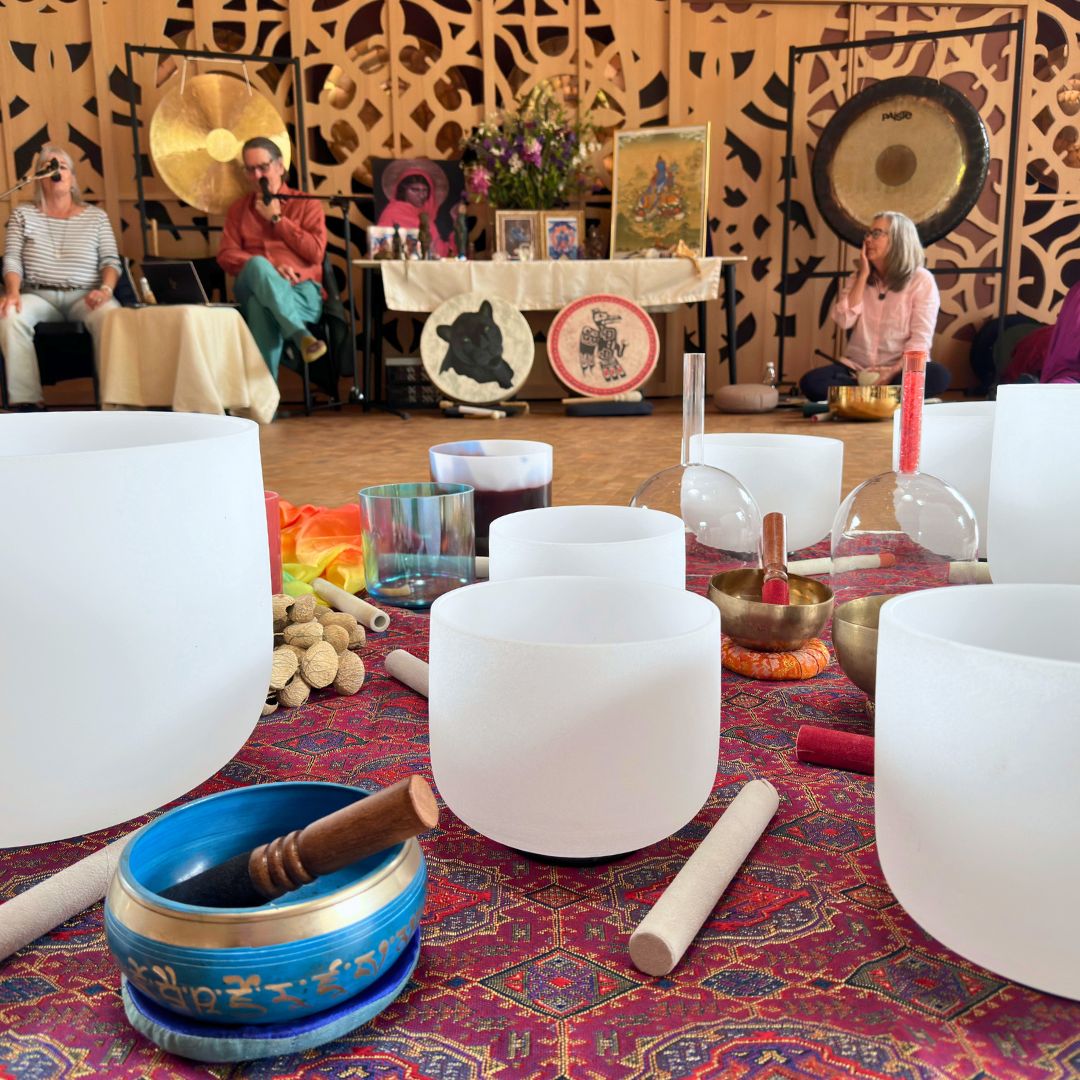
8. Crystal Bowls and Metal Bowls
A common question is whether crystal bowls are “better” than metal bowls. In truth, they are simply different tools, each with its own field of application.
Crystal bowls are loud, clear, and sustaining. They are excellent for larger groups, sound baths, yoga classes, and any situation where you want a strong, luminous sound field.
Traditional Himalayan or Tibetan metal bowls create a more complex, layered sound with many overtones. They do not sustain as long and are not usually as loud, but they can be exquisite for one-on-one sessions, massage, Reiki, bedside work, or any setting where you want the sound to support intimate, subtle processes.
It is possible to combine crystal and metal bowls beautifully, but because metal bowls contain many partial tones, they must be chosen with care to complement the crystal tones rather than clash with them. This is an area where our experience can be particularly helpful.
9. Playing Your Bowl: Essential Principles
Every bowl has its own personality and may require a slightly different touch, but some principles apply across the board.
Begin by gently activating the bowl with a light tap on the rim. Then, place your striker almost vertically against the outer wall. Rather than twisting from the wrist, allow your whole arm to move around the rim in a steady circle. This creates consistent contact, which leads to a clean tone.
The general rule is that slower is better. Many people instinctively move too fast. If you slow down and maintain a gentle, steady pressure, the bowl will often reward you with a clearer, more stable sound. As you explore, you will discover a point at which the bowl becomes too loud and the tone begins to distort. It is useful to know where this point is so you can stay just below it.
You do not need to keep the striker on the bowl continuously. Let the bowl sing on its own. You can move away, wait, and then rejoin the rim when the sound begins to soften. This makes space for the natural sustain of the bowl and gives you time to work with other bowls or simply hold the space.
Over time, you may explore more elaborate patterns—tapping out gentle rhythms, moving between harmonies and binaurals, and combining sound with your voice. But these basics will already take you a long way.
10. How to Care for Your Crystal Singing Bowl
Crystal singing bowls are remarkably durable, but they are also instruments of subtle vibration. A little mindful care ensures they remain clear, resonant, and supportive for many years to come.
General Care
Treat your bowl much like you would treat any sacred instrument—gently and with attentiveness.
A few essentials:
- Always place your bowl on an O-ring or soft cushion.
Direct contact with hard surfaces can cause buzzing or, in rare cases, stress fractures. - Avoid striking the bowl too forcefully.
Crystal bowls do not need hard activation; a light, mindful tap brings out their natural voice. - Be attentive to temperature shifts.
To ensure the longevity of your singing bowl, it is recommended to avoid sudden temperature shifts and allow the bowl to acclimate to the ambient temperature before playing it if it has been moved from a very cold or hot environment. - Clean with simple materials.
A soft cloth is usually enough. If needed, use mild soap and warm water, then dry fully before storing.
Energetic Stewardship
Many practitioners also cleanse their bowls using intention, breath, or gentle sound—less as maintenance, more as ongoing relationship. Allow yourself to discover what feels natural and true in your own practice.
11. Why Bowl Bags Are a Good Idea
Whether you travel constantly with your bowls or keep them mostly at home, a bowl bag quickly becomes one of the most important accessories you own.
Protection
Bowls are strong when played, but vulnerable when bumped, knocked, or transported. A well-padded bag helps protect against:
- Chips or cracks
- Accidental falls
- Sudden temperature changes
- The realities of a busy home or studio
Ease & Organization
Bowl bags—especially nesting bags—make your practice simpler:
- They keep bowls upright, cushioned, and safely separated
- They reduce the space needed to store multiple bowls
- They make it easy to carry bowls to classes, retreats, or clients
Longevity
Just as a drum benefits from a case, crystal bowls thrive with proper storage. A bag helps ensure:
- The bowl stays clean
- The bowl is exposed to fewer environmental fluctuations
- Your investment lasts many years without wear
A bowl bag is not just an accessory—it’s part of the ongoing care and stewardship of your instrument.

12. Intention, Attention, and Support
No matter which bowl or set you choose, the most important elements are the ones you bring inside yourself.
Sound can soften the mind and open the heart, but you are the one who chooses how to listen, how to direct your attention, and how to meet whatever arises. Intention—clear, gentle, grounded—is amplified through the bowls. Attention—steady and curious—allows the vibration to become a doorway rather than simply an experience.
If this feels new or uncertain, you are not alone. We work with people every day who are just beginning this journey or are ready to deepen it. We offer education, guidance, and space to explore how sound, consciousness, and healing meet in practice.
13. When You’re Ready to Choose
When you feel ready to take the next step, you might begin simply:
- Listen to a few different bowls and tunings, and notice which sounds you genuinely love.
- Decide whether your first step is one bowl, a small harmonic set, or a chakra-style collection.
- Consider whether you will need to play with other instruments (which will point you toward 440 Hz), or whether you will mostly be working with bowls on their own.
From there, we are happy to meet you—by phone, email, or in person—to help you translate this guide into an actual instrument or set of instruments that fits you well.
Our goal is not just to sell you a bowl, but to help you find a companion in sound that you can grow with for years to come.